
Important: These are model interview answers. Candidates should adapt them to their actual projects, technical responsibilities, software experience, and achievements rather than claiming experience they do not have.
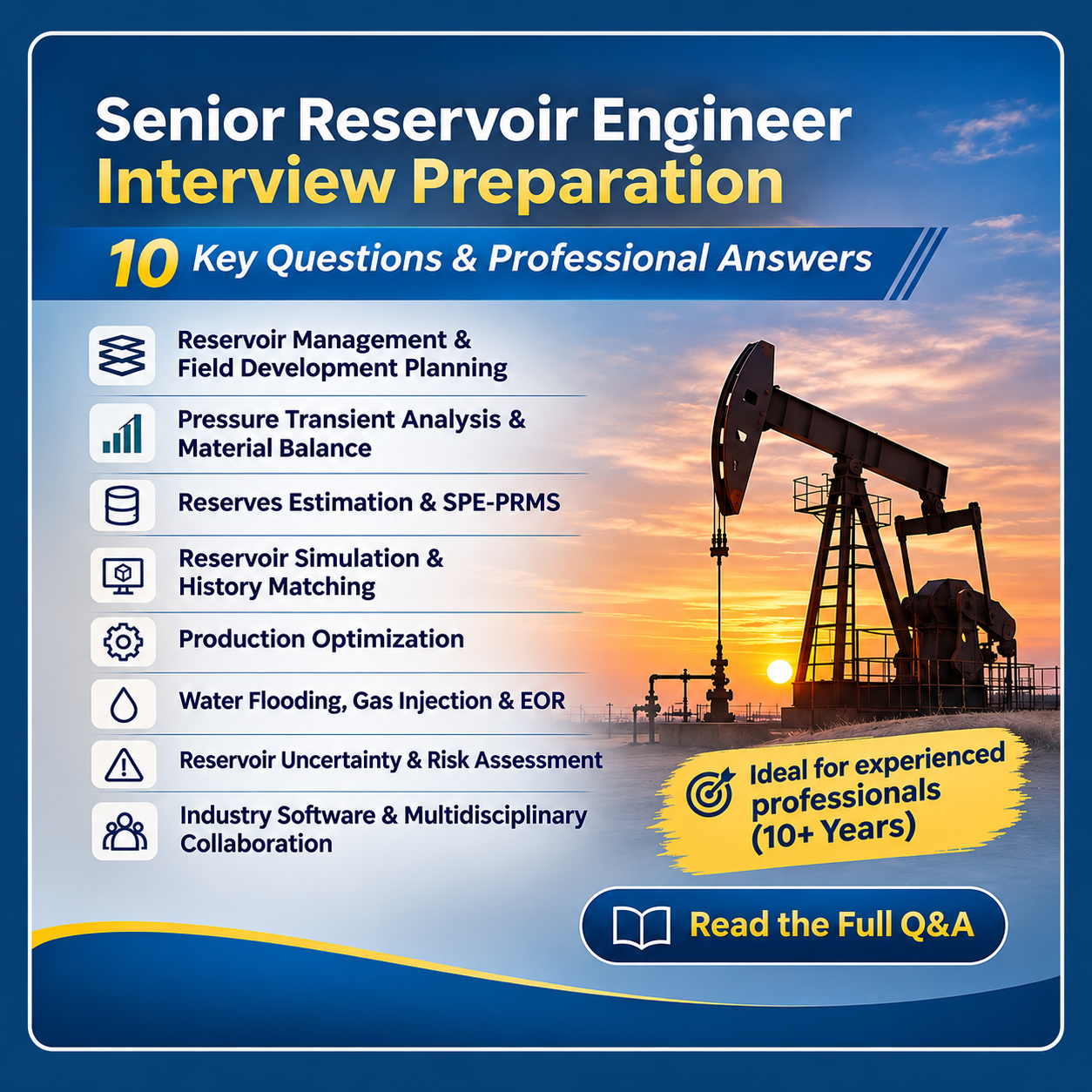
Senior Reservoir Engineer Interview Preparation – 10 Questions and Answers
Experience Level: 10+ Years
Category: Reservoir Engineering | Career Development
This interview preparation guide provides practical, professional answers to 10 commonly asked Senior Reservoir Engineer interview questions. The answers focus on reservoir management, reserves estimation, reservoir simulation, production optimization, field development planning, and technical leadership.
These are model answers. Candidates should adapt them to their actual project experience and technical responsibilities.
Throughout my career, I have been involved in various aspects of reservoir engineering, including reservoir characterization, production performance evaluation, reservoir management, reserves estimation, and field development planning.
My experience covers the integration of geological, geophysical, petrophysical, and production data to develop a comprehensive understanding of reservoir behavior and identify opportunities to maximize hydrocarbon recovery.
My key responsibilities have included:
- Evaluating reservoir properties, fluid characteristics, and hydrocarbon distribution.
- Conducting production surveillance and analyzing well performance.
- Performing reservoir pressure analysis, material balance, and decline curve analysis.
- Developing and updating reservoir simulation models to support production forecasting.
- Evaluating infill drilling, workover, recompletion, and new development opportunities.
- Supporting field development plans, including well placement, production facilities constraints, and recovery strategy selection.
- Monitoring reserves replacement, recovery factors, and production performance against approved field development plans.
At the senior level, I also take responsibility for integrating multidisciplinary inputs, challenging technical assumptions, managing uncertainties, and translating engineering studies into commercially viable development decisions.
I use an integrated reservoir surveillance approach, combining pressure data, production history, well testing, and material balance analysis to understand reservoir behavior and identify potential production issues.
1. Pressure Transient Analysis (PTA)
I analyze pressure buildup and drawdown data to estimate reservoir and well parameters, including:
- Permeability and skin factor.
- Reservoir pressure.
- Wellbore storage effects.
- Flow regimes and boundary conditions.
- Reservoir heterogeneity and potential compartmentalization.
2. Production Data Analysis
I regularly evaluate production trends, including oil, gas, and water rates, water cut, gas-oil ratio (GOR), and flowing pressures.
I use decline curve analysis to assess production decline behavior and estimate future production performance. I also investigate unexpected changes in production rates that may indicate reservoir depletion, water breakthrough, gas coning, liquid loading, or well integrity issues.
3. Well Testing
Well testing provides valuable information about reservoir deliverability and well performance.
I evaluate productivity and deliverability using appropriate well test interpretation techniques, including inflow performance relationships (IPR), gas well deliverability analysis, and pressure transient interpretation.
4. Material Balance Analysis
I use material balance techniques to evaluate reservoir drive mechanisms, estimate connected hydrocarbon volumes, and monitor pressure depletion.
For gas reservoirs, I may use P/Z analysis, while oil reservoirs may require consideration of solution gas drive, water influx, gas-cap expansion, and other applicable drive mechanisms.
Finally, I integrate the results from these methods to update the reservoir understanding and recommend appropriate actions, such as additional surveillance, well intervention, production optimization, or revised development strategies.
I use a combination of deterministic and probabilistic methods to estimate hydrocarbon reserves and resources, depending on reservoir maturity, data availability, and the level of uncertainty.
1. Volumetric Method
I use geological and petrophysical information to estimate hydrocarbons initially in place (HIIP), considering parameters such as:
- Reservoir area and net pay thickness.
- Porosity and water saturation.
- Formation volume factors.
- Oil and gas properties.
This method is particularly useful during exploration and early field development.
2. Material Balance Method
Material balance analysis helps estimate connected hydrocarbon volumes using reservoir pressure and production history.
3. Reservoir Simulation
For developed fields, I use dynamic reservoir simulation models to estimate recoverable volumes and forecast production under different development scenarios.
4. Production Decline Analysis
Decline curve analysis is applied to suitable production histories to estimate future well and field performance, subject to appropriate assumptions about operating conditions and production constraints.
5. Probabilistic Assessment
Where uncertainties are significant, I use probabilistic techniques such as Monte Carlo simulation to evaluate uncertainty in key parameters and estimate P90, P50, and P10 outcomes, where applicable.
Compliance with SPE-PRMS
I follow the Petroleum Resources Management System (PRMS) framework to ensure consistent classification and reporting of petroleum resources.
My approach includes:
- Distinguishing reserves from contingent and prospective resources.
- Evaluating commerciality and project maturity.
- Applying appropriate technical and economic assumptions.
- Assessing uncertainty and project risks.
- Ensuring reserves are associated with defined development projects.
- Maintaining proper documentation, traceability, and auditability.
I also ensure that reserves estimates reflect the applicable reporting date, economic conditions, contractual terms, and regulatory requirements.
Reservoir simulation is an important tool in my reservoir engineering workflow, particularly for understanding reservoir behavior, evaluating development strategies, and forecasting future production.
My approach generally consists of five stages.
1. Model Construction and Data Integration
I work with geological models, petrophysical properties, PVT data, relative permeability curves, fluid contacts, and production history to establish a representative dynamic reservoir model.
2. Model Initialization
I verify that the initial model correctly represents reservoir pressure, fluid distribution, hydrocarbon volumes, and other available static and dynamic information.
3. History Matching
I compare simulated results against historical field performance, including:
- Oil, gas, and water production rates.
- Reservoir pressure.
- Water cut and GOR.
- Well-level production performance.
- Field cumulative production.
I investigate mismatches by reviewing geological connectivity, aquifer strength, relative permeability, fault transmissibility, fluid properties, and well operating conditions.
My objective is to achieve a technically defensible history match rather than simply adjusting parameters to reproduce historical production.
4. Production Forecasting
Once an acceptable history match is achieved, I develop forecast scenarios to evaluate:
- Base production performance.
- New well drilling opportunities.
- Infill drilling and sidetracks.
- Water or gas injection.
- Production optimization.
- Facility and export constraints.
- Alternative development concepts.
5. Uncertainty and Sensitivity Analysis
I evaluate different geological, petrophysical, and operational assumptions to understand their impact on production forecasts and ultimate recovery.
Common simulation software includes ECLIPSE, INTERSECT, Petrel, and CMG.
Ultimately, reservoir simulation should support practical field development decisions, not just generate production forecasts.
My production optimization approach focuses on maximizing economically recoverable reserves while maintaining safe and sustainable reservoir performance.
I start by identifying the key production constraints at reservoir, well, and surface facility levels.
1. Reservoir-Level Optimization
- Evaluate reservoir pressure depletion and drive mechanisms.
- Review well spacing and drainage efficiency.
- Identify unswept or bypassed hydrocarbon zones.
- Evaluate opportunities for pressure maintenance and improved recovery.
2. Well-Level Optimization
- Review well inflow and outflow performance.
- Optimize choke settings and operating conditions.
- Identify liquid loading, water production, and gas breakthrough issues.
- Evaluate workovers, recompletions, and artificial lift opportunities.
3. Production System Optimization
I integrate reservoir performance with well and facility capabilities using nodal analysis and integrated production system modelling.
Tools such as PROSPER and GAP can help evaluate production constraints across the entire system.
4. Production Forecasting and Prioritization
I compare different production strategies based on incremental production, recovery factor, capital expenditure, operating expenditure, and economic returns.
For example, increasing production rates may improve short-term cash flow but could also accelerate water breakthrough, increase pressure depletion, or compromise ultimate recovery.
Therefore, I consider both short-term production targets and long-term reservoir value.
5. Continuous Surveillance
I establish appropriate production and pressure monitoring systems to identify deviations from forecast performance and implement corrective actions.
My objective is to achieve the optimum balance between production rate, ultimate recovery, operating efficiency, and economic value.
My approach begins with understanding the reservoir drive mechanism, fluid properties, geological characteristics, and the remaining recoverable hydrocarbon potential.
I then evaluate whether pressure maintenance, improved displacement efficiency, or another recovery mechanism is technically and economically justified.
1. Waterflooding
For waterflood projects, I evaluate:
- Reservoir connectivity and permeability distribution.
- Injector-producer relationships.
- Water injection rates and pressure limits.
- Voidage replacement ratio (VRR).
- Water breakthrough and water cut trends.
- Sweep efficiency and injection conformance.
I monitor injection and production performance to identify inefficient sweep patterns, channeling, and potential water handling constraints.
2. Gas Injection
For gas injection projects, I evaluate:
- Reservoir pressure and minimum miscibility pressure (MMP), where applicable.
- Gas composition and PVT behavior.
- Injection rate and pressure constraints.
- Gas breakthrough and recycling requirements.
- Gas availability and compression capacity.
Gas injection can be implemented for pressure maintenance, improved displacement, or miscible recovery, depending on reservoir conditions.
3. Enhanced Oil Recovery (EOR)
I assess suitable EOR methods based on reservoir characteristics, including:
- Chemical flooding.
- Polymer flooding.
- Surfactant flooding.
- Miscible gas injection.
- CO2 injection.
- Thermal recovery methods.
The selection depends on reservoir temperature, pressure, oil viscosity, salinity, permeability, fluid compatibility, infrastructure, and economic considerations.
4. Project Evaluation
Before recommending an injection project, I conduct technical and economic assessments covering incremental recovery, injection requirements, facilities modifications, operating costs, and project risks.
I also recommend pilot testing when uncertainties are significant.
Reservoir uncertainty management is a critical part of field development planning because geological and dynamic uncertainties can significantly affect production forecasts, reserves, and project economics.
I typically classify uncertainties into three main categories.
1. Geological Uncertainties
- Reservoir structure and fault interpretation.
- Reservoir continuity and connectivity.
- Net-to-gross ratio.
- Porosity and permeability distribution.
- Fluid contacts.
- Reservoir compartmentalization.
2. Dynamic Uncertainties
- Relative permeability and capillary pressure.
- Aquifer strength.
- PVT properties.
- Pressure communication.
- Fluid movement and sweep efficiency.
- Well productivity and reservoir deliverability.
3. Operational and Commercial Uncertainties
- Well availability and production uptime.
- Drilling success and development timing.
- Production facility capacity.
- Export limitations.
- Operating costs and commodity prices.
Sensitivity Analysis and Risk Assessment
I identify the parameters with the greatest impact on key project outcomes, such as recoverable reserves, production plateau, cumulative production, and project NPV.
I use sensitivity analysis, scenario modelling, and probabilistic methods to quantify their potential impact.
For example, I may evaluate low, base, and high cases for reservoir permeability, aquifer strength, and recovery factor.
Where sufficient data are available, I use Monte Carlo simulation to develop probabilistic production and reserves forecasts.
I then rank the uncertainties based on their impact and identify opportunities to reduce them through additional data acquisition, appraisal drilling, well testing, or improved reservoir surveillance.
My objective is to ensure that development decisions remain robust across a reasonable range of reservoir uncertainties.
I have experience using reservoir engineering and integrated modelling tools to support reservoir characterization, production surveillance, reserves evaluation, simulation, and field development planning.
My software experience can be categorized into the following areas:
| Software | Main Applications |
|---|---|
| ECLIPSE | Black-oil and compositional reservoir simulation |
| INTERSECT | Advanced reservoir simulation |
| Petrel | Geological modelling, static modelling, and simulation workflows |
| CMG | Reservoir simulation, compositional modelling, and thermal recovery |
| MBAL | Material balance and reservoir performance analysis |
| PROSPER | Well modelling and nodal analysis |
| GAP | Integrated production system modelling |
| OFM | Production surveillance and data analysis |
I select software based on the engineering problem rather than using a particular application by default.
For example:
- I use MBAL for material balance analysis and reservoir drive mechanism evaluation.
- I use ECLIPSE or INTERSECT for dynamic reservoir simulation and forecasting.
- I use Petrel for integrating geological and reservoir models.
- I use PROSPER for well performance and nodal analysis.
- I use GAP for integrated production optimization and network constraints.
At the senior level, my responsibility extends beyond software operation. I focus on validating input data, understanding model assumptions, reviewing results, challenging technical conclusions, and ensuring that engineering outputs support sound business decisions.
Reservoir engineering is inherently multidisciplinary. Effective collaboration is essential to ensure that reservoir development decisions are technically integrated and operationally achievable.
My approach is to establish common objectives, ensure consistent data interpretation, and maintain regular technical communication across disciplines.
1. Collaboration with Geologists and Geophysicists
I work with subsurface teams to understand reservoir architecture, structural interpretation, fault connectivity, depositional environments, and uncertainty in reservoir distribution.
These inputs are essential for constructing representative static and dynamic models.
2. Collaboration with Drilling and Well Engineering Teams
I work with drilling engineers to evaluate well placement, target intervals, trajectory design, completion strategies, and drilling risks.
I provide reservoir-based recommendations to improve drainage efficiency and reduce the risk of drilling unsuccessful or poorly positioned wells.
3. Collaboration with Production and Operations Teams
I work closely with production engineers and operations personnel to review well performance, identify production constraints, and optimize operating conditions.
This includes evaluating water production, gas breakthrough, pressure depletion, artificial lift performance, and well intervention opportunities.
4. Collaboration with Facilities and Process Engineers
I ensure reservoir development assumptions are consistent with surface facility capacities, compression requirements, water handling, gas processing, and export limitations.
5. Technical Leadership and Decision-Making
As a senior engineer, I facilitate technical reviews, challenge assumptions constructively, communicate risks, and ensure recommendations are supported by evidence.
I also translate complex subsurface evaluations into clear technical and economic recommendations for management.
Ultimately, successful reservoir management requires an integrated team approach where subsurface understanding, well design, production operations, and facilities planning work toward a common asset development strategy.
I would develop a long-term reservoir management strategy based on an integrated understanding of reservoir characteristics, current production performance, remaining hydrocarbon potential, and the asset's commercial objectives.
My approach would consist of six key elements.
1. Establish a Reliable Reservoir Understanding
I would review all available geological, petrophysical, PVT, well testing, production, and pressure data.
I would assess the current reservoir model and identify uncertainties that could materially affect development decisions.
2. Establish a Reservoir Surveillance Framework
I would implement a systematic monitoring program covering:
- Reservoir pressure and pressure depletion.
- Well productivity and injectivity.
- Oil, gas, and water production.
- Water cut and GOR trends.
- Injection performance.
- Well integrity and production availability.
The objective would be to identify early signs of reservoir underperformance and take corrective action.
3. Identify Opportunities to Improve Recovery Factor
I would evaluate opportunities such as:
- Infill drilling and additional development wells.
- Sidetracks and recompletions.
- Improved reservoir sweep.
- Water and gas injection.
- EOR implementation.
- Recovery from bypassed or unswept zones.
Each opportunity would be assessed based on technical feasibility, incremental recovery, and economic value.
4. Develop Production Optimization Strategies
I would integrate reservoir, well, and surface facility performance to identify production bottlenecks.
This could include well operating optimization, artificial lift improvements, gas compression upgrades, water handling improvements, and production system debottlenecking.
5. Manage Production Decline and Long-Term Development
I would establish production forecasts using reservoir simulation, decline curve analysis, and integrated production system modelling.
I would regularly compare actual performance against forecast and update development strategies based on new information.
I would also evaluate alternative development scenarios to maintain economically sustainable production while maximizing ultimate recovery.
6. Ensure Economic Value and Technical Governance
I would rank development opportunities based on incremental reserves, production potential, capital requirements, operating expenditure, project NPV, and risk.
I would ensure that reserves assessments, development plans, and technical recommendations follow applicable industry standards and internal governance requirements.
My overall objective would be to maximize the long-term economic recovery of the asset while maintaining safe, reliable, and efficient operations.
Additional Senior-Level Interview Tips
For candidates with more than 10 years of experience, interviewers typically expect more than theoretical knowledge. They want evidence of technical ownership, engineering judgment, and leadership.
| Interview Focus | What You Should Demonstrate |
|---|---|
| Technical Expertise | Strong understanding of reservoir engineering fundamentals. |
| Practical Experience | Real examples of reservoir problems and solutions. |
| Decision-Making | Ability to evaluate technical and economic trade-offs. |
| Leadership | Ability to lead multidisciplinary studies and influence decisions. |
| Business Understanding | Ability to maximize recovery and asset value. |
Five Additional Questions You Should Prepare For
- Describe a challenging reservoir engineering problem you encountered and how you solved it.
- How do you challenge a reservoir simulation model when the forecast does not agree with actual production performance?
- How would you manage a mature oil or gas field experiencing significant production decline?
- How do you prioritize competing capital investment opportunities across multiple assets?
- Describe a technical recommendation you made that significantly improved production, reserves, or project economics.
How to Structure Your Interview Answers
Use the STAR method:
- Situation: Describe the reservoir or field challenge.
- Task: Explain your responsibility.
- Action: Explain the engineering analysis and decisions you made.
- Result: Quantify the outcome, where possible.
For example, rather than saying:
"I optimized gas production using reservoir simulation."
A stronger answer would explain the initial production constraint, the modelling approach, the scenarios evaluated, the selected solution, and the resulting improvement in production or recovery.
Final Advice for Senior Reservoir Engineer Candidates
A Senior Reservoir Engineer interview is not just about demonstrating knowledge of reservoir simulation, material balance, reserves estimation, or production forecasting. It is about demonstrating that you can:- Understand complex reservoir behavior.
- Make technically defensible development decisions.
- Manage uncertainty and reservoir risks.
- Optimize production and maximize recovery.
- Lead multidisciplinary technical teams.
- Translate engineering studies into commercial value.
PetroTopic.com | Petroleum Engineering Resources | Reservoir Engineering Career Development